




Critical Thinking and Logic Guide to Constructing Syllogism Mood and Figures

FOUR FORMS OF STANDARD CATEGORICAL PROPOSITION: A, E, I, O
Have you have come across the following question?
- Construct syllogism of the following moods and figures:
a)EIO b)AAA c)III d)AEE e)IOI f)AOO g)AEE h)OOO
You will need first to learn on Terms in Critical thinking as explained below before solving them.
BASIC TERMS IN CRITICAL THINKING AND LOGIC
- Arguments – it is a set of propositions in which a claim (truth of one proposition) is claimed to be inferred.
- Truth value: is the quality of a claim to be true or false- either true (T) or false (F)
- Proposition- it is a statement that has truth value. some sentences that do not qualify to be propositions are interrogatives/questions, exclamations and commands.
- Premise- it is a an assumption or starting point in an argument from which other statements (conclusions) are logically derived.
- Subject (S)- is the main person, object, or idea that a premise or conclusion is talking about.
- Predicate term (P)- is part of a statement that is usually in a premise or conclusion) that tells something about the subject. It is denoted by (P) and it describes or makes a claim about the subject in a premise or conclusion.
- Conclusion- A conclusion is the final inference or judgment that an argument aims to establish.
- It represents the logical end point, derived from and supported by the given premises. For example, in the above argument, the conclusion is ‘Therefore, Socrates is mortal.’
- A claim is a declarative statement that can be evaluated as either true or false

Features of an arguments
1.They have special indicators in the conclusion
Indicators in deductive argument | Indicators in inductive argument |
Definitely | Probably |
Absolutely | Likely |
Certainly | Unlikely |
Necessarily | Possibly |
e.g Premise 1: All humans need water to survive. | e.g Premise 1: The last four times it rained, there were traffic jams on the highway. |
2. There Is Connection Or Logical Link Between The Premise(s) And The Conclusion That Is Strong And Convincing. There Is Strength Of The Inferential Between The Premise And The Conclusion.
Example:
All kenyans are Athlete Tom is a kenyan Therefore, Tom is an athlete In this argument there is a logical flow from premises to conclusion
|
3. The Subject Of The First Premise (The Main Person, Idea Or Thing That The Premise Is Talking About) Is Fully Included Or Excluded In The Object (Predicate Term) Of Conclusion
- Example in deductive argument

Example in inductive argument

Types of prepositions
1.Compound Prepositions
2.Simple Prepositions
A. Compound Prepositions
They are statements formed by combining two or more simple propositions using logical connectives.
Types of compound Preposition
Hypothetical prepositions
- They take a form of if S then P
- e.g If it is sunny then it is wet
Disjunctive proposition
- Takes a form of either S or P
- e.g He is either bright or foolish
Conjunctive proposition
- Takes a form of Both S and P
- e.g He is both royal and bright
By conditional proposition
- Takes a form of S and only if P
- e.g You will be rich if and only you work hard
B. Simple propositions/ Standard propositions
a)Categorical proposition
- Categorical preposition affirms that subject class is either partially or fully included or excluded from the predicate class
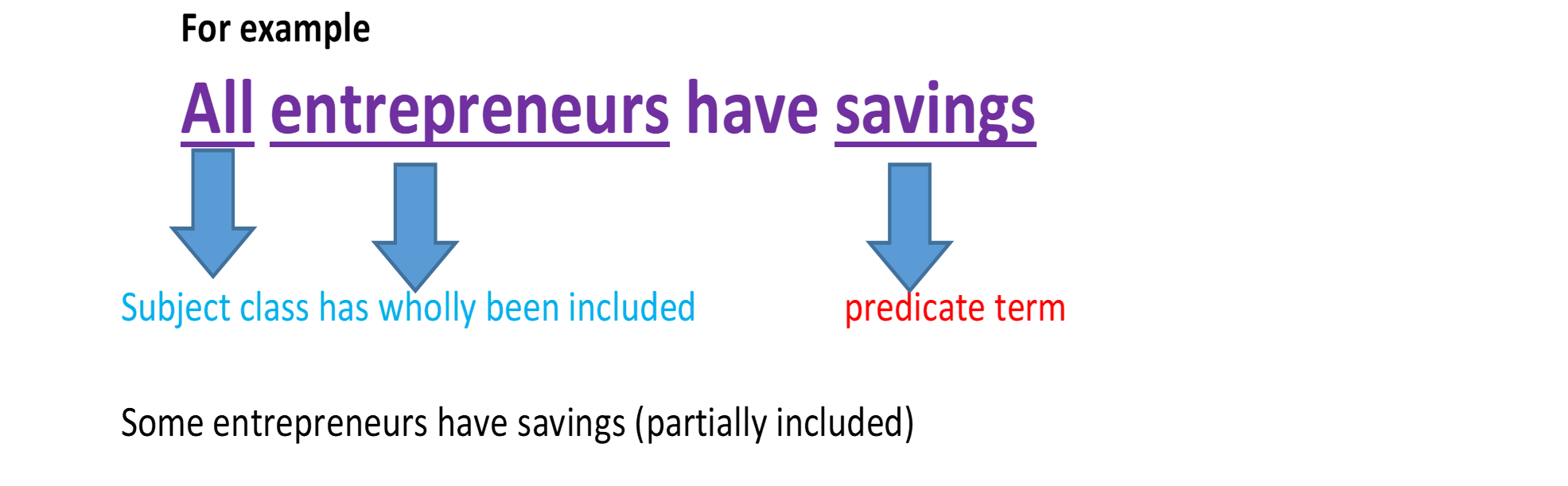
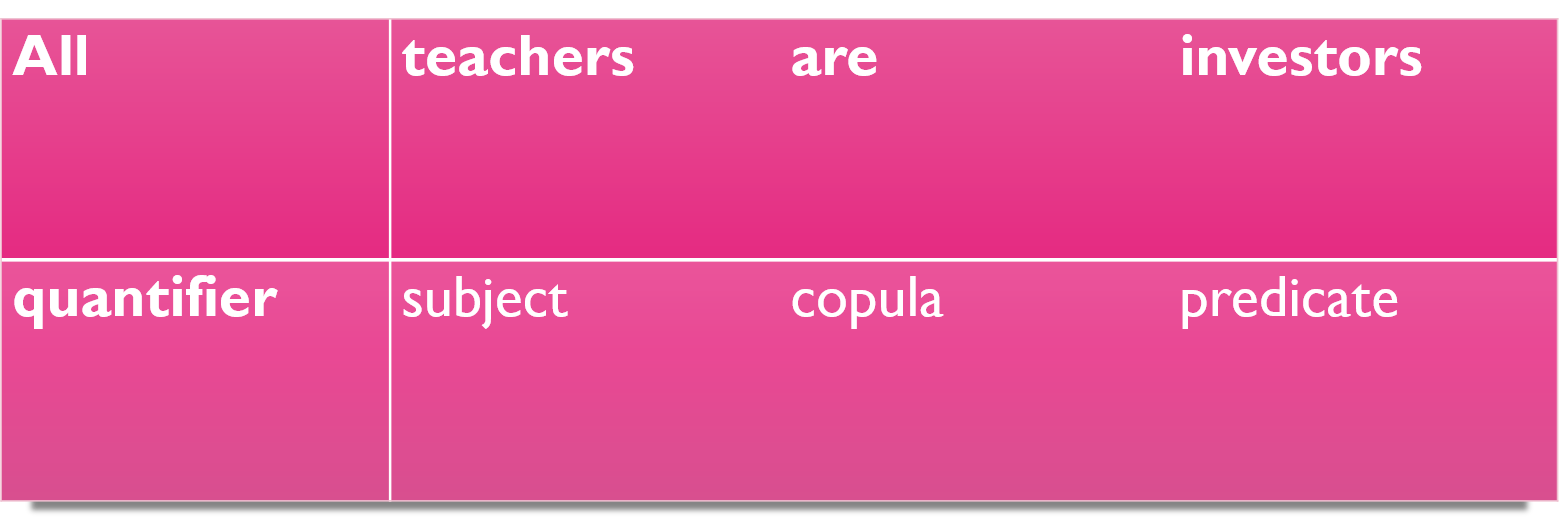
PARTS OF A STANDARD SIMPLE CATEGORICAL PROPOSITION
1.Quantifier gives specification of how much the subject is included or excluded in the predicate class e.g(All ______are________, some_____are_____)
2.Subject term- it is the term used to represent the subject
3.Copula- it is the form of the verb to be
4.Predicate term – it is the term that represents the predicate term
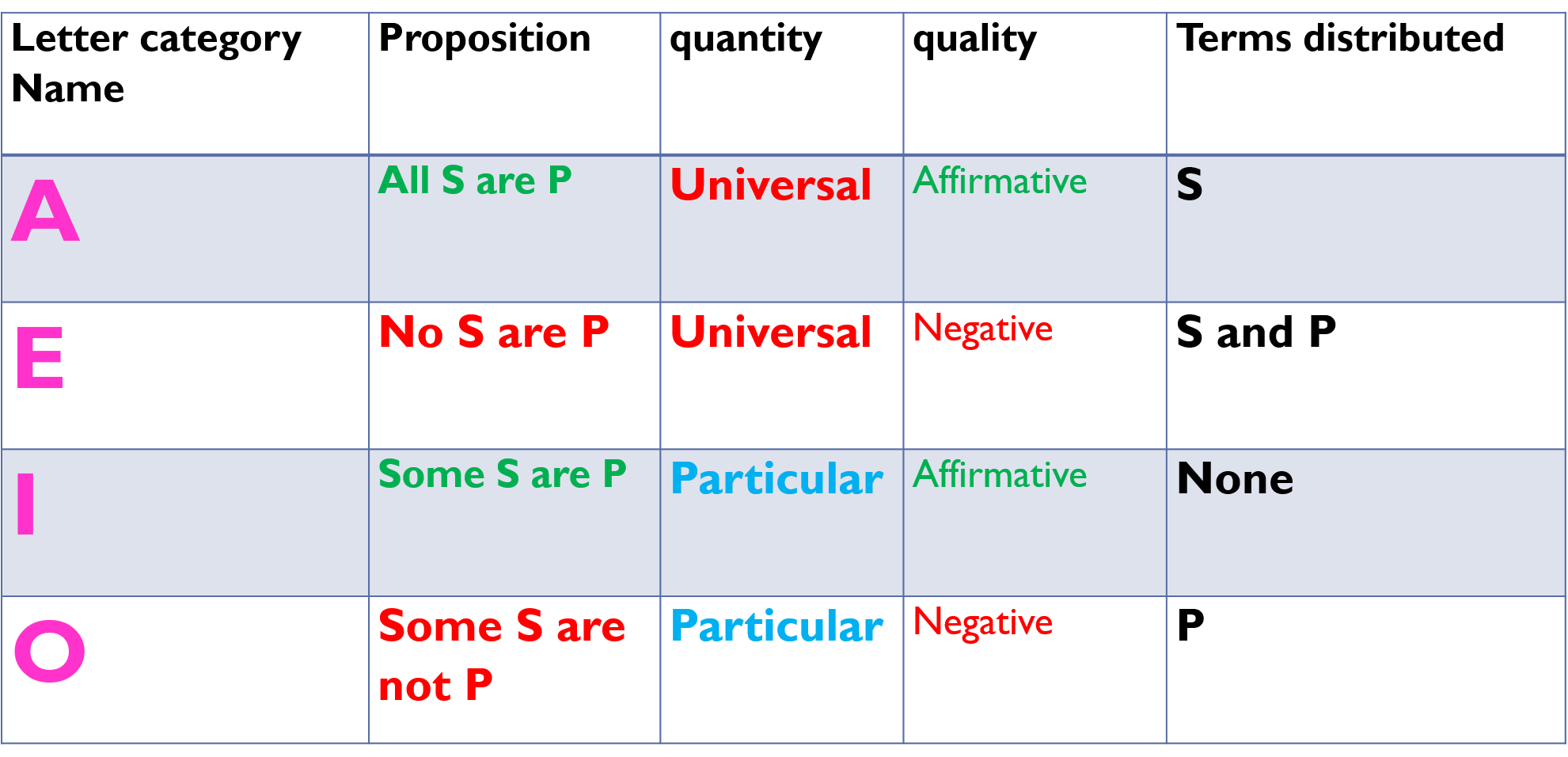
FOUR FORMS OF STANDARD CATEGORICAL PROPOSITION
- Standard categorical proposition is a type of logical statement that asserts or denies a relationship between two groups or categories, often expressed in the standard forms.
Standard categorical proposition takes four forms:
- A
- E
- I
- O
1) A- Takes a form of All S are P – Universal affirmative- agreeing all
e.g All mammals breath in Oxygen
2) E- takes a form of NO S are P- Universal negative
e.g No Bats are birds
3) I- takes a form of Some S are P – particular affirmative
E.g Some fruits are vegetables
4) O- takes a form of Some S are not P – particular negative
e.G Some roses are not flowers
Summary of 4 forms of Standard categorical proposition (SCP)
Points to Note on Standard categorical propositions
- Standard categorical propositions (SCP) A and E are called Universal as they make reference to all members of its subject (I.e. ALL ________are ________ or No______are ______)
- Standard Categorical propositions I &O are called particular as they make reference to some of its members of its subject class
Propositions that affirms inclusion of its subject either partially or fully into the predicate class are called Affirmative ( A-Universal Affirmative and I - Particular Affirmative)
Standard categorical propositions A is called Universal Affirmative as it affirms inclusion of its subject fully into the predicate class
Standard categorical propositions I is called Particular Affirmative as it affirms partial inclusion of its subject into the predicate class
Standard categorical propositions that are negative (E &O) – asserts exclusion of the subject in predicate class fully or partially
Standard categorical propositions E assert fully exclusions of the subject in the predicate class (Universal Negative)
Standard categorical propositions O assert partial exclusions of the subject in the predicate class (Particular Negative)
Let us now make it easier on how to solve the following Questions
Construct syllogism of the following moods and figures:
a)EIO
b)AAA
c)III
d)AEE
e)IOI
f)AOO
g)AEE
h)OOO
Worry No more!!!!!! Click the article on Syllogism we will use the Knowledge learnt to solve them
SYLLOGISM
Introduction to Syllogism
A syllogism is a form of deductive reasoning in which a conclusion is drawn from premises.
As a deductive reasoning, the syllogism must have
- 2 premises (Major and minor)
- 1 conclusion drawn from the premises
Types of syllogism
- Standard categorical syllogism –
- Conditional syllogism/hypothetical syllogism – takes a form of if A is true then B is also true. They are invalid. Example:
All hawks fly
Hawks live in nests
Therefore, nests fly
- Disjunctive syllogism – takes a form of either A or B is true. Therefore, if A is true B is false and vice versa.
e.g
students are either disciplined or obedient
Tom is not a disciplined student
Therefore, Tom is obedient
STANDARD
CATEGORICAL SYLLOGISM
The Standard categorical syllogism is an argument that comprises of three categorical propositions and each having three terms each of which appears twice and is used in the same sense in the argument but used only once in each proposition.
Features of a categorical syllogism
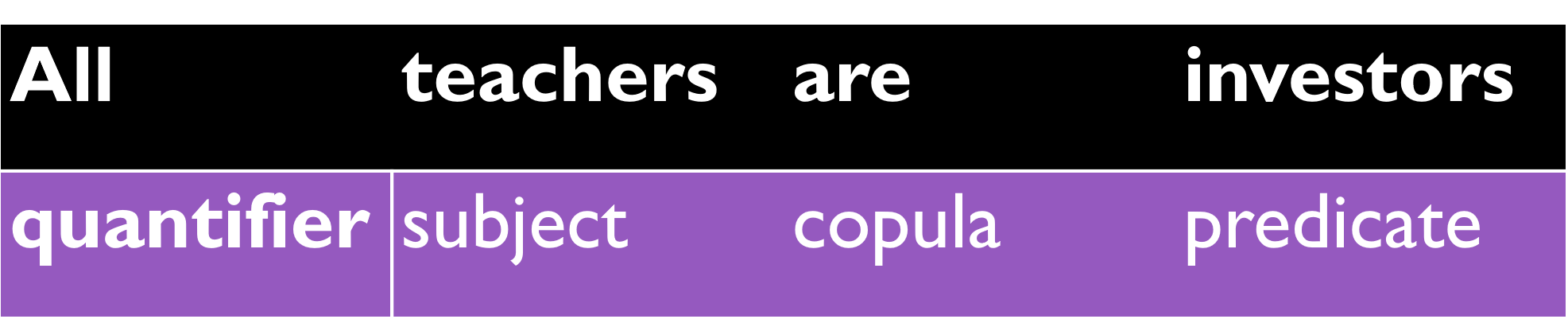
Therefore, a categorical syllogism has the following features:
- Has three categorical syllogism
- Have 3 terms each of which appearing twice in propositions but used only once in each proposition
- e.g
- All dogs are black – major premise
- Tommy is a dog – minor premise
- Therefore, tommy is black- conclusion
The terms in this argument
- Dogs- is the subject class of major premise
-it is also the predicate class of the minor premise
- Black- is the predicate term of the major premise and the predicate term of the conclusion
- Tommy- is a subject term/ class of the minor premise and subject class of conclusion
How to identify the major premise and middle term in an argument
- The major premise is the one that has the major term (predicate of conclusion)
- The major term is the predicate of conclusion which is also the predicate of the major Premise.
How to identify middle term
- Middle term- appears in two premises but does not appear in the conclusion
The Six rules of a valid categorical Syllogism
- Since we will be constructing syllogism moods and figures, it is important to identify the rules of categorical syllogism to ensure validity of argument.
- Remember a valid argument in deductive reasoning is the one that, conclusion follows necessarily from the premises.
1.The argument must have three terms in propositions
I. Major term – predicate term of conclusion
II. Minor term – subject term of conclusion
III. Middle term- the one that must appear in two premises but does not appear in the conclusion
Example
No entrepreneurs love saving
Joy is an entrepreneur
Therefore, Joy does not love saving
In this example:
- Saving-Major term – predicate term of conclusion
- Joy- Minor term – subject term of conclusion
- Entrepreneur- Middle term- the one that appear in two premises but does not appear in the conclusion
The middle term must be distributed at least in one of the premises-to avoid committing a fallacy of undistributed middle term.
- Any term that is used in the conclusion must also be distributed in the premises in which it occurs- (either as subject or predicate of either major or minor premise) to avoid committing a fallacy of illicit process.
- A standard categorical syllogism can only have one negative premises but not two- to avoid committing a fallacy of exclusive premises. For example:
- No entrepreneurs loves saving
- Joy is not an entrepreneur
- Therefore, joy does not love saving
5.A standard categorical syllogism cannot have negative conclusion unless it has a negative premise. Example:
All horses are animals.
All animals are living things.
Therefore, no horses are living things.
The above argument is invalid But the following Argument is valid:
No reptiles are mammals.
All crocodiles are reptiles.
Therefore, no crocodiles are mammals
6. A valid categorical syllogism cannot have two universal syllogisms (either All S are p or No S are P) and a true conclusion as it causes existential fallacy.
CONSTRUCTING SYLLOGISM MOODS AND FIGURES
The Mood in categorical syllogism refers to the combination of the type of categorical propositions (A, E, I, O) that are used in an argument as the premises and conclusion.
The moods are:
- A
- E
- I
- O
Recap of the Summary of 4 moods of Standard categorical syllogism
Figures in the categorical syllogism
The figure in the categorical syllogism refers to the specific positioning of the middle term within the premises (major premise and minor premise).
The Four Possible figures- position of middle term in a standard categorical syllogism
Remember, the middle term is the term that appears in both premise but not in conclusion.
Example of Syllogism moods that can be constructed are:
- AAA, AEE, IOI, AOO, AEE, OOO, AII etc
Example of a mood for AII
It means it has:
A = Universal Affirmative (All S are P)
I = Particular Affirmative (Some S are P)
I = Particular Affirmative (Some S are P)
Example:
All brokers are professionals.
Some teachers are brokers.
Therefore, some teachers are professionals.
THE POSSIBLE FIGURES
In a categorical syllogism, figures refer to the different arrangements of the middle term (the term that appears in both premises but not in the conclusion) within the two premises. There are four possible figures.
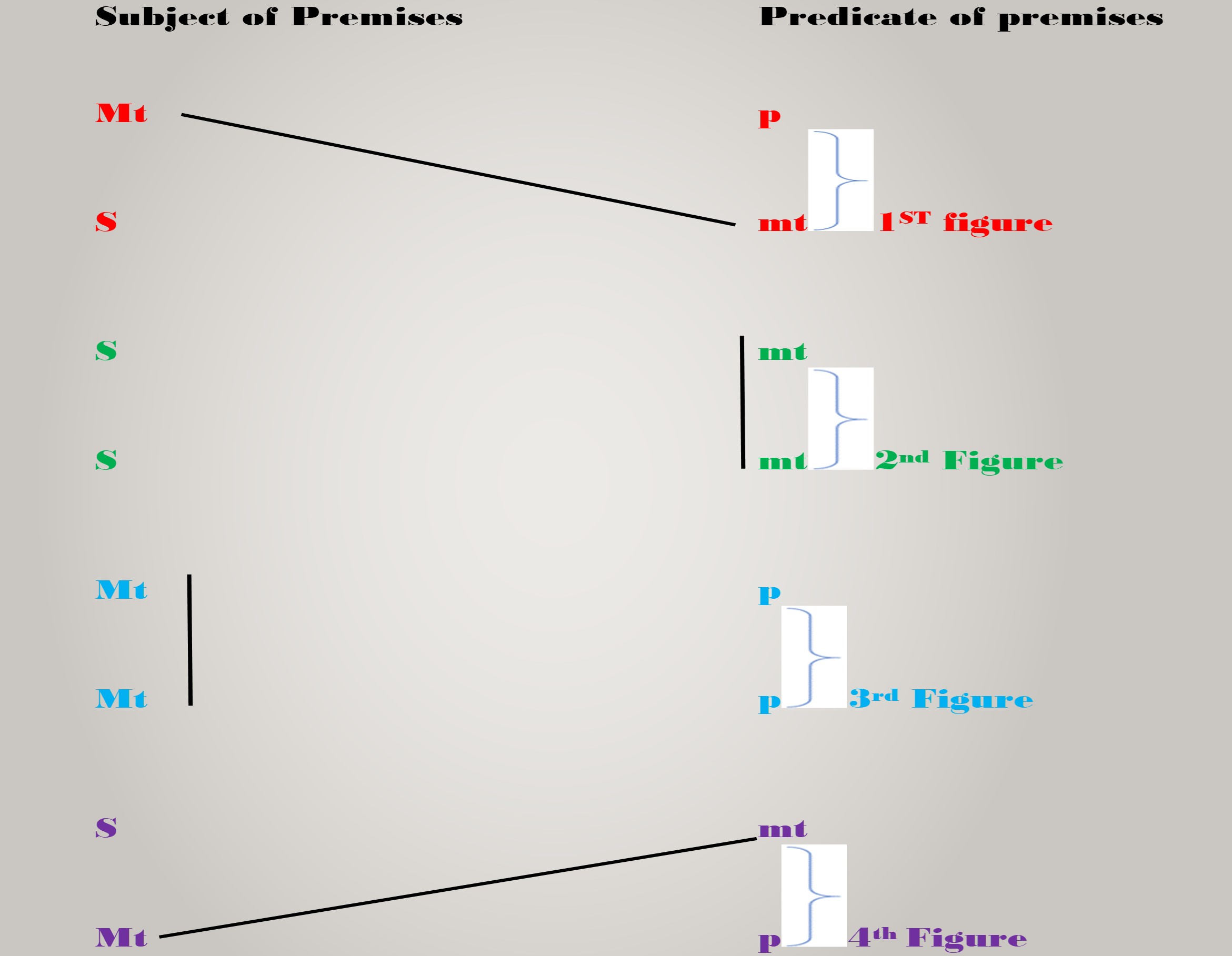
- 1st figure- it appears when middle term is the subject of the major premise but predicate of the minor premise.
- 2nd figure- occurs when the middle term is the predicate term of both premises.
- 3rd figure- the middle term appears as the subject of both premises.
- 4th figure- middle term is the predicate of the major term or subject term of the minor premise.

NOTE:
- MT symbolizes major term
- P- symbolizes the predicate term
- S- symbolizes the Subject term
Examples: EIO
No students are savers
Some farmers are savers
Therefore, farmers are not students
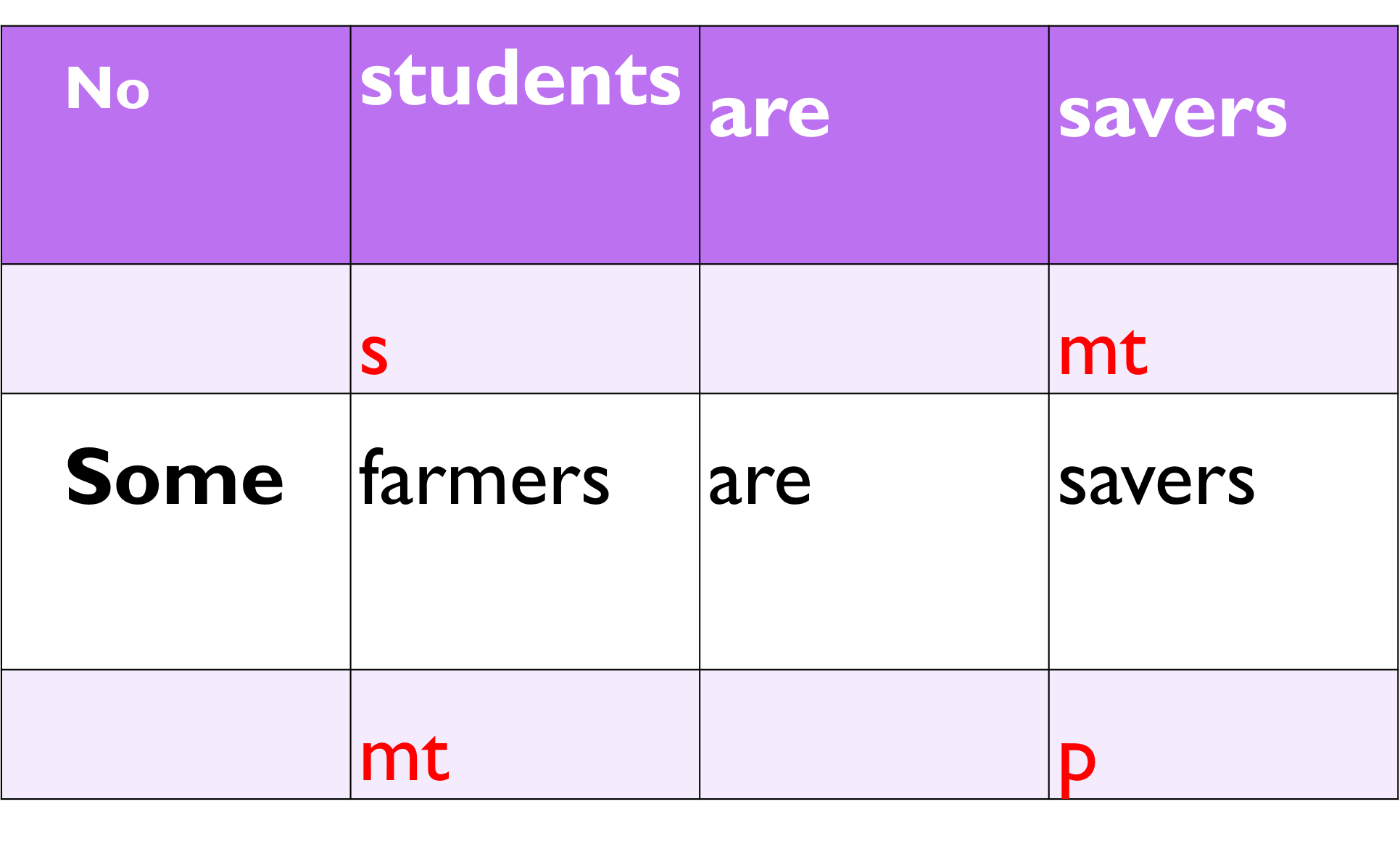
In the argument above for example:
This takes the fourth figure of
S- MT
Mt-p
- In the argument above the figure can be determined by identifying position of middle term.
- The major premise is the first premise as it is the one with predicate term of the conclusion (student)
- The Middle Term(MT) is the word savers as it appears in two premises but does not appear in the conclusion.
Summary of the figures in Syllogism
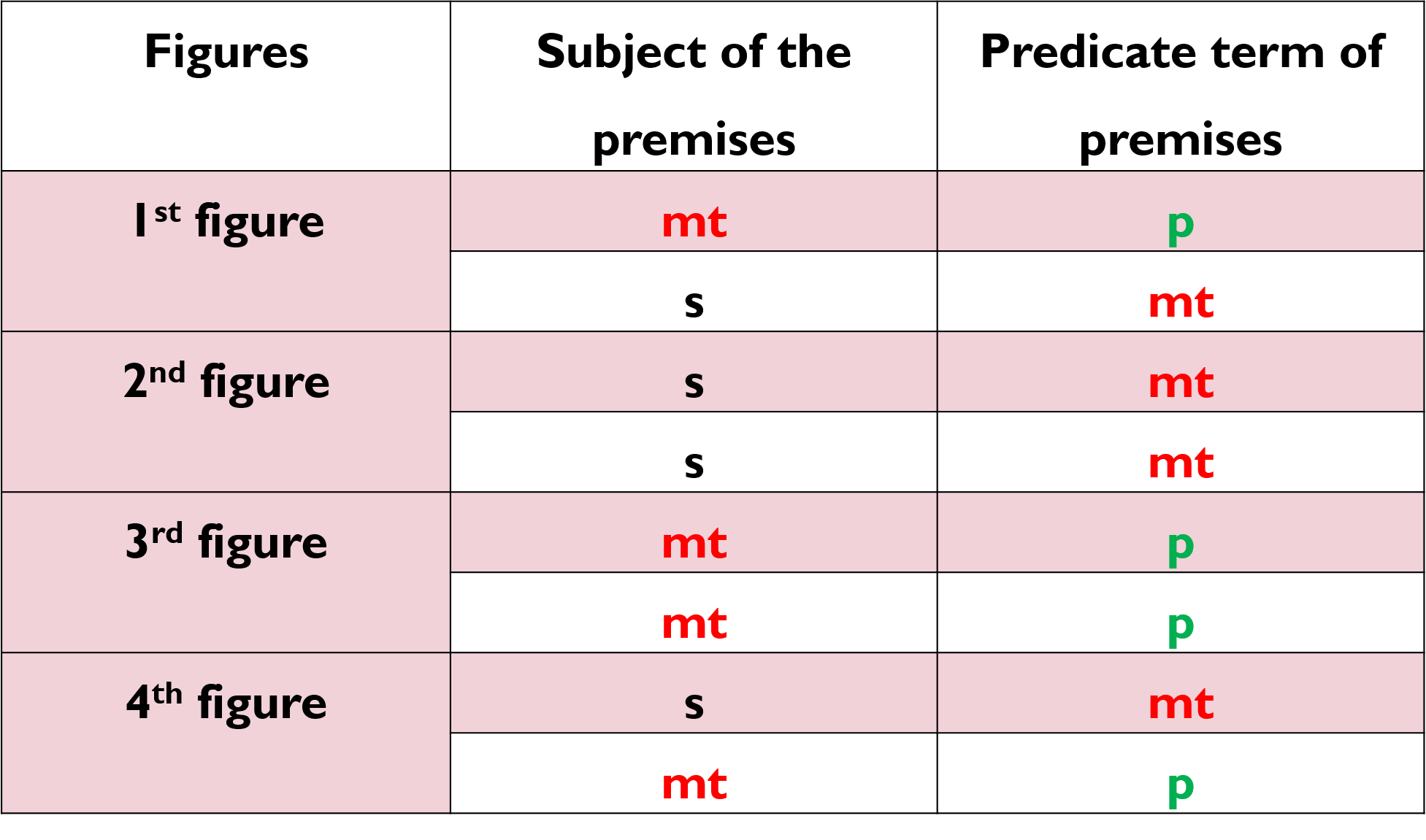
We can easily construct the syllogism figures using the pattern below to make it easier to identify Middle Term, Subject and Predicate Term
From the pattern above we can create the figures in a table as shown below:
Lets now focus on answering the questions on constructing syllogism of the moods and figures:
Answers to the questions
Construct syllogism of the following moods and figures:
- EIO
- AII
- IAI
- III
- IOI
- AOO
- AEE
- OOO
- AAA
1. Syllogism mood and figure of EIO
Remember the major term holds the predicate of conclusion. Let us look of the summary of the categorical syllogism table again:
EIO takes syllogism mood of
E- No S are P Universal Negative
I- Some S are P Particular Affirmative
O- Some S are not P Particular Negative
Example
E- No Farmers are thieves
I- Some goons are thieves
O-Therefore, some goons are not farmers
Figure of EIO
First we will identify the major premise
- The major premise is the one that has the major term (predicate of conclusion)
- The major term is the predicate of conclusion which is also the predicate of the major Premise.
- The major premise is thus The First Premise as it has Farmers- the predicate of conclusion.
- Secondly we identify the MT (middle term) which is the word investors as it appears in two premises but does not appear in the conclusion
Middle term is thus -Thieves the predicate both premises
MT is - thieves
Therefore, EIO Takes the figure of:
S MT
S MT
- Which is 2nd figure
SYLLOGISM MOOD AND FIGURE OF AII
AII takes a syllogism mood of:
A-- All S are P Universal Affirmative -1st premise
I-- Some S are P Particular Affirmative -2nd premise
I-- Some S are not P Particular Negative- conclusion
- Example
All teachers are investors- A (minor premise
Some investors are politicians- I (major premise)
Therefore, some teachers are politicians- I conclusion
The figure of AII
- First we identify the major premise which is - the second premise with (politician) – the predicate of conclusion
- Secondly we identify the MT (middle term) which is the word investors as it appears in two premises but does not appear in the conclusion
- We re arrange the propositions to start with the major premise (the second one above)
We re-arrange the propositions to start with the major premise (the second one above)
Some investors are politicians- (major premise)
All teachers are investors- (minor premise)
Therefore, some teachers are politicians- (conclusion)
Therefore AII takes the figure of 1st figure
Mt – p
s- mt
This is because:
- middle term is subject of major premise
- and middle term is predicate of minor premise
- This is the 1st figure where: middle term is the subject of the major premise but predicate of the minor premise.
Constructing Syllogism mood and figure of OOO
OOO takes the mood of:
Some S are not P Particular Negative- O
Some S are not P Particular Negative- O
Some S are not P Particular Negative- O- Conclusion
The figure of OOO is thus:
- Major premise is the first one as it had students the predicate of conclusion
- Middle term (mt) is investors as it appears on both premises
- The figure of OOO is thus:
S- mt
S- mt
- Which is the 2nd figure where middle term is the predicate of both major and minor premise
Example:
Some students are not investors
Some farmers are not investors
Therefore, some farmers are not students
Syllogism mood and figure of IAI
- IAA takes a syllogism mood of:
Some S are P Particular Affirmative – I- Premise 1
All S are PUniversal Affirmative- A- Premise 2
Some S are P Particular Affirmative- I- conclusion
Example:
Some thieves are corrupt- I
All thieves are worshippers- A
Therefore, all worshippers are corrupt- I
IAI takes a figure of:
- The major term is corrupt as it is the predicate of the conclusion
- The major premise is the first premise as it has the predicate of conclusion (corrupt)
- The middle term (MT) is the word thieves as it appears in both premises
- Therefore IAI takes a figure of:
- Mt p
- Mt p
Which is the 3rd figure where middle term appears as the subject of both premises
Summary of the syllogism figures
How to Draw the syllogism figure Chart
Identify the pattern of the mt in figures
EXERCISE
Can you now be able to Construct syllogism of the following moods and figures:
a)AAA
b)III
c)AEE
d)IOI
e)AOO
f)AEE
- We will provide detailed answers in our next session. Thank you!
ATTENTION !!!! ATTENTION !!!! ATTENTION !!!!
Have you come across the following critical thinking questions?
Question 1:
If the Statement some sinners are thieves is false,
Determine the truth value of:
a)Sinners are thieves
b)No sinners are thieves
c)Some sinners are thieves
d)All sinners are thieves
Suppose the statement some sinners are thieves is True
- Determine the truth value of the following propositions:
a)Sinners are thieves
b)No sinners are thieves
c)Some sinners are thieves
d)All sinners are thieves
Question 2: Given that No lions are cats is false
- Determine the truth value of the following
a)Lions are cats
b)Some lions are cats
c)Some lions are not cats
d)All lions are cats
Suppose No lions are Cats is True
- Determine the truth value of the following
a)Lions are cats
b)Some lions are cats
c)Some lions are not cats
d)All lions are Cat
Click the Article below We have adequately solved them Using Traditional Square of Opposition in the Link below:
Traditional Square of Opposition
https://sirjoscomputershub.co.ke/2025/07/07/traditional-square-of-opposition/
